
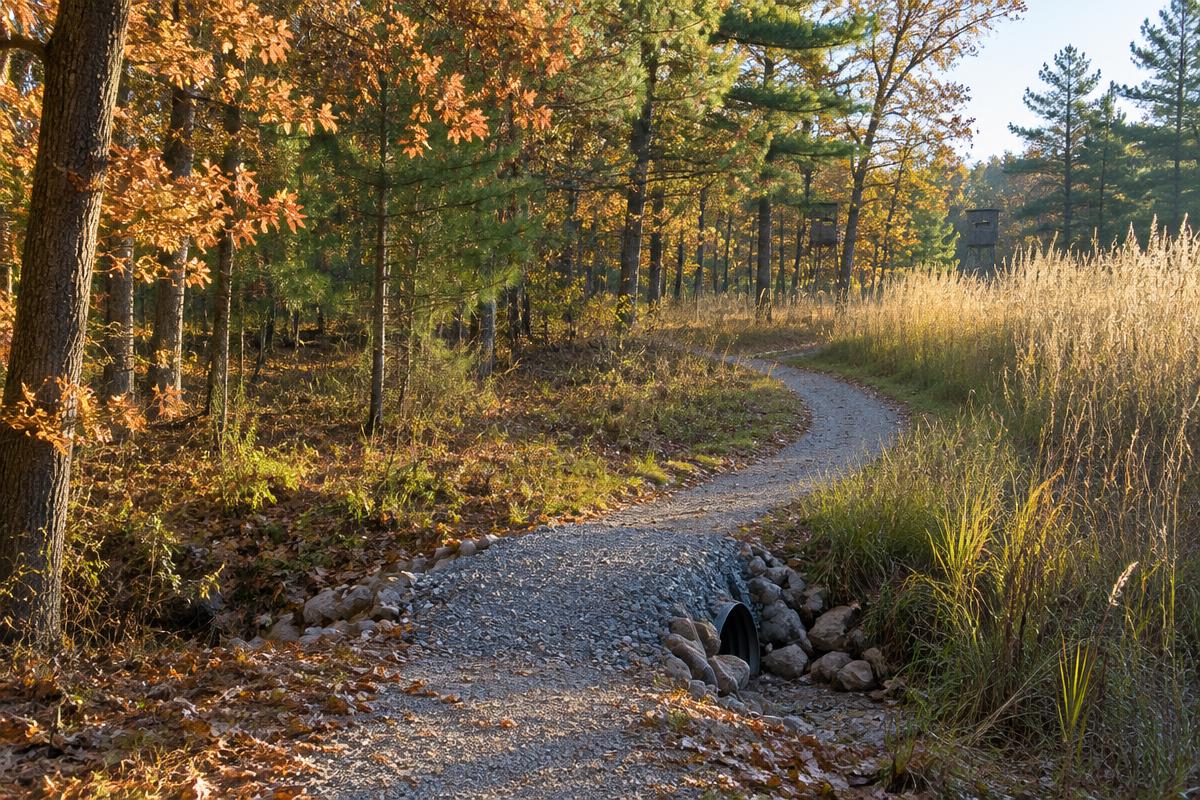
Here's the scoop: the best stand on your property isn't much good if getting into it tells every deer you're coming.
Quiet access starts well before opening a trail with a mower or ordering gravel. It's a layout problem first. Where are deer likely to be when you arrive? Where will your scent travel? Can you leave without crossing the food source you just hunted?
In northwest Wisconsin, add wet ground, crunchy leaves, shifting winds, and early darkness to the picture. A practical access route has to work in real conditions, not just as a neat line on a map.
Plan the exit before choosing the stand
It's easy to picture sneaking into an empty plot in the afternoon. Leaving after deer have gathered there is the harder part.
Before settling on a stand location, trace the whole trip. Can you step down and move away behind cover? Will your route take you across the main deer trail? Does the return to the truck pass another bedding area or feeding opening?
Sometimes moving a stand a short distance creates a much better exit. Sometimes the right answer is hunting a connecting trail rather than sitting directly on the plot.
There isn't always a perfect route. The goal is to recognize the tradeoffs before repeated hunts teach deer where to expect you.
Give wind a vote in the trail layout
A quiet walk still leaves scent. Plan access with the expected wind in mind, including where it carries odor while you're moving—not just where it goes once you're seated.
Terrain and temperature changes can complicate that picture. On calm days, air tends to rise uphill in the morning as the ground warms and sink downhill in the evening as it cools. An evening route along a creek bottom can carry your scent to every deer bedded below you, even when the forecast wind looks fine.
Watch conditions on the property and build alternatives when practical. Two modest access options may be more useful than one elaborate trail that works only on a narrow range of winds.
If a route sends scent straight into occupied bedding cover, saving a few steps probably isn't worth it.
Use screening without building a tunnel
Existing conifers, brush pockets, terrain, and woodland edges can help hide movement. Keep those features when laying out the route.
Where screening is missing, consider vegetation suited to the site and the amount of maintenance you can provide. Don't assume a newly planted screen will offer immediate concealment or remain standing through every winter condition.
Leave enough space to walk without brushing against vegetation constantly. A route can be visually hidden and still noisy if every step scrapes a branch or catches clothing.
Avoid clearing a broad, straight sightline into the area you're trying to approach. Gentle bends and retained cover can help break up visibility.
Mow for a purpose
Brush mowing can reclaim an overgrown route and reduce the stems that slap boots and equipment. Keep the width matched to the actual use.
A walking path doesn't need the same footprint as a route intended for tractors, lime delivery, or food plot equipment. On the other hand, a trail that's too narrow for required maintenance will eventually get widened—possibly at the wrong time.
Schedule mowing and trimming ahead of anticipated use where possible. Inspect for hanging limbs, stumps, and trip hazards. Keep ongoing traffic out of sensitive cover rather than using maintenance as a reason to visit it constantly.
Check the Wisconsin DNR for current season dates and county baiting/feeding rules.
Put gravel where it solves a problem
Gravel can improve durability on suitable access lanes, equipment approaches, and selected trouble spots. It isn't automatically the quietest walking surface, and it won't fix poor drainage by itself.
A durable trail depends on its base, shape, drainage, and expected loads. Dumping stone into deep mud can turn into an expensive disappearing act.
Consider whether rerouting onto firmer ground is simpler than rebuilding a wet crossing. Where gravel is appropriate, choose the section and construction approach for the actual job, not just appearance.
You may want equipment access to stop short of the stand, with a separate walking approach for the final stretch. A maintained grass path may suit that last section better than loose stone, especially where you can keep it drained and free of tall stems.
Handle water before it handles the trail
Watch where water crosses the proposed route during snowmelt and rain. A trail that blocks that flow can create ponding, erosion, and soft spots elsewhere.
Culverts may be appropriate at some crossings, but sizing, placement, cover, and outlet protection matter. A culvert that's too small backs water up, and one set too high washes out underneath. In Wisconsin, placing a culvert or crossing in a navigable stream generally requires a DNR permit, and wetlands have their own rules, so check with the DNR before disturbing the area.
Don't rut through a wet spot until it becomes a permanent trench. Wait for suitable conditions, reroute, or design a proper crossing. Even frozen-looking ground needs an honest check before equipment enters.
Good access should make the property easier to maintain while keeping hunting disturbance low. Walk your plan in both directions before committing to it.
Need a route that works beyond the map? Request an estimate from The Dirt Depot for gravel trails, brush mowing, selective land clearing, and access improvements planned around your ground.