
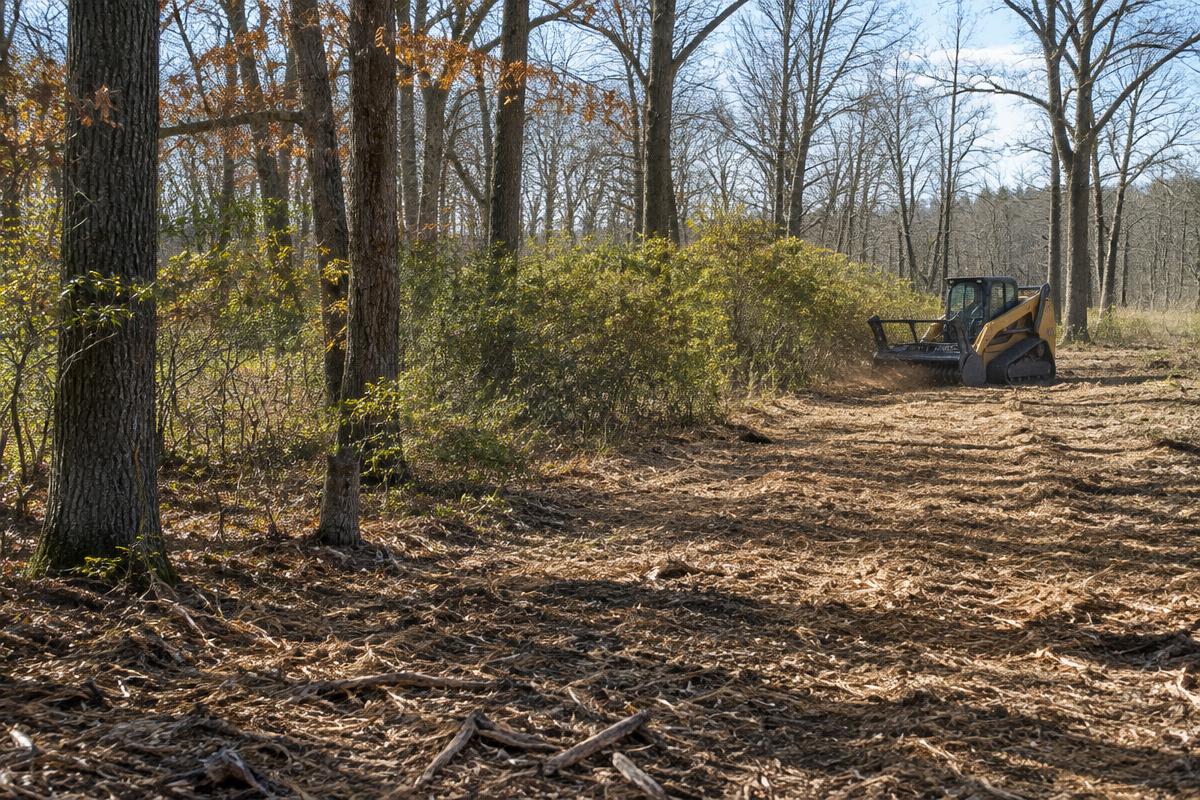
Here's the scoop: if you can see a long way through your woods at deer height, the property may have plenty of trees but not much low cover.
A closed canopy can limit sunlight reaching the ground. With too little light, the shrubs, young trees, and herbaceous plants that provide screening and browse may struggle to develop. Deer might travel through that timber without finding much reason to bed there.
Forestry mulching and selective edge work can help change that. The goal isn't to make everything look cleaned up. It's to create the conditions for useful vegetation while keeping the cover and structure that already work.
Start by identifying what you have
Before choosing trees or brush to remove, walk the site and look at it from several angles.
Where does sunlight reach the ground? Where is regeneration already growing? Which pockets provide dense screening? Are there desirable shrubs, young oaks, conifers, or other features worth protecting?
Also look for invasive buckthorn and honeysuckle. A thick shrub layer isn't automatically good habitat if invasive plants are crowding out a more diverse understory.
Identify plants before treating them. Not every honeysuckle is invasive, and leaf-off identification can be challenging. When you're unsure, get qualified help rather than clearing first and asking questions later.
Open the canopy with a purpose
Sunlight is a tool. Use it where it can support the next stage of growth.
Depending on the site, that might mean creating small openings, widening selected edges, or removing undesirable stems around existing regeneration. It doesn't necessarily mean clearing an entire block.
Remember that mulching understory brush beneath an unchanged, dense overstory may not deliver enough additional sunlight to build the cover you want. If larger canopy trees need removal, that may require separate tree work, appropriate equipment, and a more detailed plan.
Keep useful cover connected. Scattered openings with retained screening can be more practical than one large exposed area, especially near travel routes or bedding pockets you don't want to disrupt.
What forestry mulching can—and can't—do
Forestry mulching cuts and processes suitable vegetation in place. It can open overgrown ground, reclaim selected edges, and create access without requiring every cut stem to be hauled away.
But the machine doesn't finish the habitat project by itself.
A heavy layer of processed material can delay establishment in some areas. Soil conditions, remaining vegetation, sunlight, and the depth of residue all influence what grows next.
Mulching also doesn't necessarily kill the root systems of woody plants. Some species resprout vigorously. If the objective is lasting control, especially of invasive shrubs, plan the follow-up before the first pass.
Agree on boundaries, retained plants, access routes, and the desired finish before work begins. A clear plan helps avoid removing the very features you're trying to improve.
Treat invasive control as an ongoing job
Buckthorn and invasive honeysuckle can take advantage of added sunlight too. Opening the canopy without managing those plants may simply give them a better growing opportunity.
Control methods depend on species, plant size, site conditions, and the time of year. Mechanical removal, repeated cutting, and carefully selected herbicide treatments may each have a place.
When herbicides are appropriate, follow the label, use the correct treatment method, and account for nearby desirable plants and water. Get qualified assistance where needed.
Return to inspect regrowth and seedlings. An existing seed bank or nearby seed source can keep producing new plants after mature shrubs are removed. One tidy-looking winter pass is not proof the infestation is gone.
Two Wisconsin rules of thumb worth knowing
Spot buckthorn in late fall. Common buckthorn usually keeps its green leaves into November, after most native shrubs have dropped theirs. A walk through your woods right now is one of the easiest times to see how much you have and where it is.
Leave oaks alone April through July. Oak wilt is present across much of Wisconsin, and the Wisconsin DNR advises against cutting, pruning or otherwise wounding oaks during the high-risk period from April through July. Fresh wounds attract the beetles that carry the disease. Plan any edge work that touches oaks for the dormant season, which is another reason fall and winter are good times for this job.
Cutting alone doesn't kill buckthorn or honeysuckle. Both resprout from the stump, often with several new stems. Lasting control usually means treating fresh-cut stumps or following up on the resprouts. If you hire someone to apply the herbicide, Wisconsin requires them to be a certified and licensed commercial applicator.
Build a soft edge instead of a hard wall
A soft edge is a transition between open ground and taller timber, with grasses, forbs, shrubs, or young trees providing intermediate structure.
Along a food plot, that transition can offer screening and browse while making the opening feel less abrupt. Irregular boundaries and retained pockets of cover may be more useful than a straight, uniformly cleared strip.
Keep maintenance realistic. You may need selective mowing, invasive control, or periodic cutting to keep the edge from becoming something different than intended. Leave yourself an accessible perimeter for that work, without turning a sheltered bedding area into a busy equipment shortcut.
Use dormant-season opportunities carefully
Dormant work can make certain clearing tasks easier to schedule, and firmly frozen ground may reduce disturbance. It doesn't guarantee damage-free access. Deep snow can hide obstacles and insulate unfrozen soil.
Avoid saturated ground and stop when conditions create rutting. Consider erosion risk, wetlands, and site-specific restrictions before choosing equipment routes.
Then give the response time to develop. Check sunlight, native regeneration, invasive regrowth, and screening over subsequent growing seasons. Bedding use depends on security and disturbance as well as vegetation.
Ready to improve cover without clearing away its value? Request a forestry mulching and land clearing estimate from The Dirt Depot, including practical edge work and a plan for follow-up brush management.